 Jeff Utecht
For most of the last century, the career ladder did a quiet job for leaders. It explained the future without anyone having to say much. You did the work, you put in the time, and the next rung was roughly where you expected it to be.
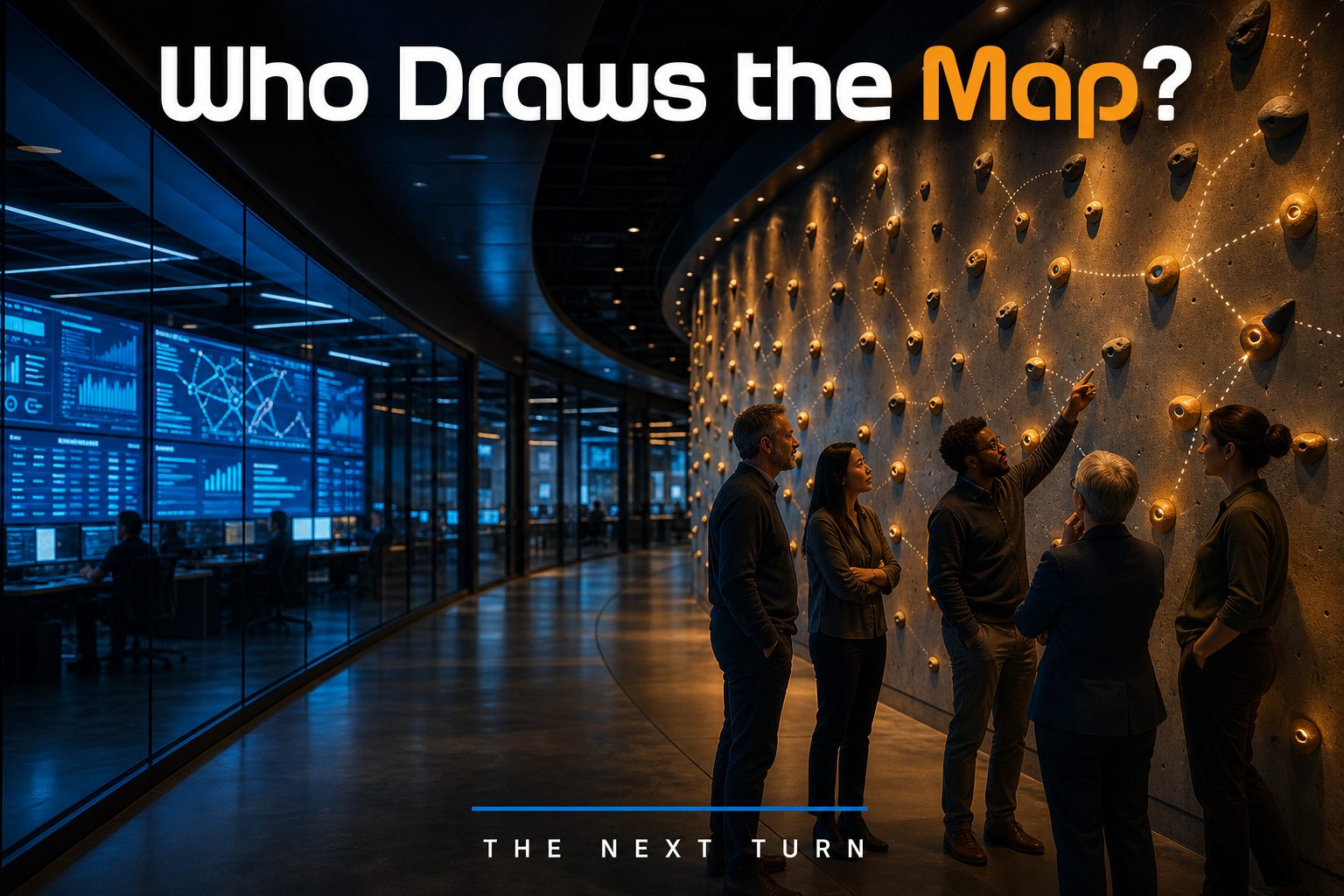
That ladder is bending. In a Fortune piece this week, Microsoft’s chief economic opportunity officer said AI is replacing it with something closer to a climbing wall, where progress is not always upward. I think he is right about the shape. But the more important part of his argument is what he says has to come with it: radical transparency.
Because a climbing wall only works if people can see the holds.
Key takeaways
- AI is changing the career ladder into a climbing wall, where growth can move sideways as well as up.
- New Pew Research Center analysis shows that change is not landing evenly: in more AI-exposed occupations, employment growth has differed sharply by gender and education.
- When the path to growth is no longer obvious, leaders have to explain it. Silence about how AI is changing a role is not neutral.
- Radical transparency is a leadership practice, not a communications campaign: define how growth works now, role by role.
What’s happening: the career ladder meets AI
In a November 2 Fortune piece by Kristin Stoller, Aneesh Raman, chief economic opportunity officer at Microsoft, repeated a prediction he has been making for months: the traditional career ladder is dying, and in its place is a “climbing wall.” Speaking at Aspen Digital’s WIN Summit in late October, he described a future where “you start to climb in ways that are unique to you.” His answer to the problem that creates is what he called “radical transparency,” which the article describes as making sure workers understand how AI is changing their jobs and what opportunities they have.
The same article points to an October 22 Pew Research Center analysis by senior researcher Nicole Smith, and the numbers are worth slowing down for. Pew built an AI exposure score for 480 occupations based on how many of each job’s important tasks generative AI can do or assist with. Comparing 2017–19 with January 2023 through June 2026, Pew found that for each 1-point increase in an occupation’s AI exposure score, men’s employment grew by 6.3%, while women’s barely changed (0.2%).
The gap was concentrated among workers without a bachelor’s degree. Among workers with a high school diploma or less, men’s employment grew by 8.8% for each 1-point increase in exposure, while women’s fell by 9.5%. For workers with a bachelor’s degree or higher, neither group’s employment changed significantly. Pew is careful here: it says the relationship between AI exposure and job growth “is not necessarily direct,” because other changes during the period may also have affected employment, and that it is too early to know whether these technologies will lead to job loss or growth in the long run.
Smith’s own takeaway, as quoted by Fortune, was about access to the conversation: “We need to change our mindset and to make sure that we open these conversations to women.”
Put the two pieces together and you get one story. The path forward is changing shape, and it is not changing the same way for everyone.
What this reveals: the ladder was never just a structure
In Chapter 1 of The Next Turn, “When What Worked Stops Working,” I describe the old shared definition of work: show up, put in the time, show visible effort, stay loyal, and progress gradually. The ladder was the physical form of that definition. It answered questions before anyone asked them. How do I grow here? What happens if I stay? What does the next three years look like?
Those questions used to answer themselves. Now they do not.
The Next Turn
That is the collision I write about throughout the book. The definition of work, meaning what people believe work is for and what it should give back, was already shifting. Now the structure of work, meaning how tasks actually flow and who or what does them, is shifting underneath it. AI changes which tasks make up a role. When the tasks change, the rungs move. And most organizations have not told anyone where they moved to.
This is where the value exchange from Chapter 5 becomes urgent. I argue that people now assess value first and build loyalty only if the exchange proves itself over time. One of the clearest tests of that exchange is simple: what growth can someone actually see in their first three years? On a ladder, the answer was implied. On a climbing wall, it has to be shown. If the holds are invisible, staying starts to look like drift, and people make the rational choice to look elsewhere.
The Pew data adds a harder layer. When paths become less obvious, the people who already have access to information, sponsors and informal conversations are the ones who find the holds. Everyone else is left guessing. That is not a motivation problem. It is a design and communication problem, and it sits squarely with leaders.
In Chapter 12, “Defining Work Again,” one of the seven moves is to define AI’s role in the work before employees define it informally. I would add that this includes AI’s role in careers. If leaders do not explain how AI is changing a role and what growth now looks like, people will fill that silence with their own story. Usually it is the most anxious one available.
Ambiguity is not neutral.
The Next Turn
And in Chapter 14, “The Leader as Translator,” I argue that this moment calls for credibility over confidence: naming tension honestly, defining what matters, explaining tradeoffs and admitting what is still being learned. Radical transparency is exactly that. It does not require leaders to know where every role will be in five years. It requires them to say what they know, what they don’t, and how people can grow in the meantime.
This is where credibility becomes more important than confidence.
The Next Turn
Notice what this is not. It is not a Gen Z initiative or a program for one group. A climbing wall changes the path for the 24-year-old analyst, the 45-year-old operations lead and the 60-year-old specialist alike. No one is outside this one.
Your next turn
Here are five moves for leaders and managers this week:
- Map one role honestly. Pick a role on your team and list which of its core tasks AI now does or assists with. Then ask: which growth steps in this role depended on those tasks?
- Draw the holds. For that same role, write down three ways someone can grow in the next three years, including sideways moves. If you cannot name three, that is your finding.
- Say what you don’t know. In your next team meeting, share what you know about how AI is changing your work, what is still uncertain, and when you will update people. Credibility comes from the honesty, not the certainty.
- Check who is in the conversation. Look at who has had a career conversation with you in the last six months. Who has not? The people without access to informal guidance are the ones a climbing wall leaves behind.
- Separate the standard from the signal. If promotion in your area still rewards time in seat or visible effort, ask what standard those signals were standing in for, and whether you can measure that standard directly.
Frequently asked questions
Is AI really ending the career ladder?
AI is changing which tasks make up many roles, and that changes the steps people used to climb. Microsoft’s Aneesh Raman describes the replacement as a climbing wall, where progress can move sideways as well as up. The ladder is not disappearing overnight, but leaders should not assume the old path still explains itself.
What does radical transparency about AI mean for managers?
It means telling people plainly how AI is changing their job, what opportunities that creates, and what is still unknown. It is not a one-time announcement. It is an ongoing conversation built into one-on-ones, development plans and role design.
Is AI affecting all workers’ careers the same way?
Not according to early data. Pew Research Center found that in more AI-exposed occupations, employment growth since 2023 has differed by gender and education, with the largest gap among workers without a bachelor’s degree. Pew notes the relationship is not necessarily direct, but it is a signal that leaders should check who has access to new paths.
The wall needs holds
I don’t think the end of the ladder is something to mourn. Plenty of people never fit it. A climbing wall can offer more ways to grow, not fewer. But only if someone makes the holds visible.
That is the new burden on leadership I keep coming back to on this blog: making explicit what used to be assumed. The career path used to be assumed. It can’t be anymore.
So here is the question to sit with this week: if someone on your team asked you today how they grow here now that AI is changing the work, what would you actually tell them?
Sources
- A Microsoft exec says AI is killing the career ladder. But its replacement comes with a catch — Fortune, November 2, 2026
- Men Are Experiencing More Job Growth Than Women in AI-Exposed Occupations — Pew Research Center, October 22, 2026
