 Jeff Utecht
Most organizations have spent the past year asking how to get people to use AI. Far fewer have asked the harder question underneath it: what should the work, and the roles that hold it, look like now? That is what AI role redesign means, and new research this week suggests almost no one is doing it.
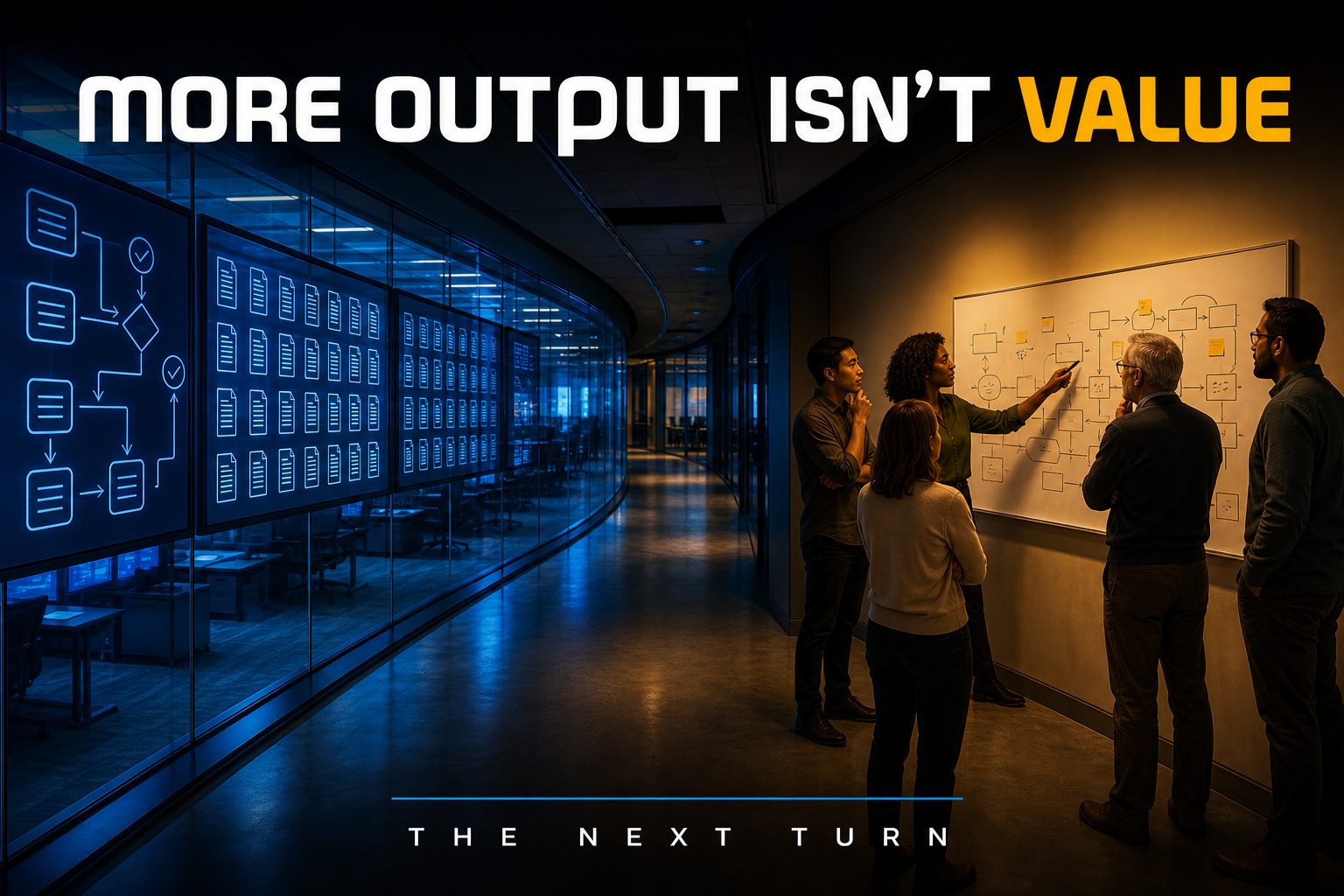
At the same time, one finance chief made a point every leader should hear. Producing more is not the same as getting better.
The tools are arriving. The redesign is not.
Key takeaways
- A Gartner survey of 2,002 CIOs and technology executives found only 4% have plans to redesign roles for a workforce of humans and AI agents.
- Organizations with those plans were 2.4 times more likely to be top AI performers, according to Gartner.
- Workday’s CFO argues AI should be measured by better work and better decisions, not by more output.
- AI role redesign is a leadership task: define what the work is for, where judgment sits and what changes once the workflow changes.
What’s happening
On October 23, HR Dive (republishing CIO Dive) reported on a Gartner survey on how CIOs are preparing their workforce for AI agents. The survey, released October 19 as part of Gartner’s 2027 CIO and Technology Executive Agenda, covered 2,002 CIOs and technology executives. Only 4% said they have plans to redesign roles for a human-agent workforce. Those that do were 2.4 times more likely to be top AI performers and to have CEOs who report value from AI. Meanwhile, only 13% reported significant or transformational value from their AI investments, and 58% said their companies are pushing for cost improvements from earlier AI spending.
Gartner VP analyst Alicia Mullery offered a candid explanation for why talent gets pushed aside: the cost of technology “can overshadow some of the talent pieces because it’s not as immediate as an expensive bill.”
Two days earlier, Fortune’s Sheryl Estrada published an interview with Workday CFO Zane Rowe on how finance chiefs should measure AI. Rowe pushed back on a narrow focus on return: “I always hear people talk about ROI, and I think it’s so much more than that.” His example was simple. A finance team that can produce twice as many reports with AI has not necessarily improved the business. The better test is whether the team uses AI to spot insights, anticipate problems, advise leaders and make better decisions. He also said the goal is not only efficiency, but “people actually doing the work that they thought they were going to do.”
And on October 22, Fortune covered a new Goldman Sachs analysis of AI and job displacement. Among its details: only 23% of U.S. establishments have built AI into regular workflows. Goldman economist Joseph Briggs also noted that, historically, most labor disruption from automation has been concentrated in recessions rather than in healthy economies.
Put those three together and a pattern appears. Pressure to show AI value is high. Measurable value is still rare. And the one move most associated with value, redesigning roles, is the one almost nobody has planned.
Why AI role redesign is the missing step
In The Next Turn, I describe two changes happening at once. The first turn is the definition of work: what people believe work is for and what it should give them in return. The second is the structure of work: how tasks actually flow, who or what does them, and how quality gets proven. This week’s news sits squarely in the second turn, and it shows what happens when organizations change the structure without redefining anything around it.
In Chapter 6, “AI Is Not a Tool,” I argue that AI is becoming infrastructure. When leaders see a tool, they delegate it downward and track adoption. When they see infrastructure, they start asking different questions about workflow, effort and judgment.
Leaders who miss that will keep solving for adoption when they should be solving for redesign.
The Next Turn
The Gartner numbers read like a measurement of that gap. Almost every organization is investing. Very few are redesigning. And the ones that redesign are the ones more likely to see value.
Rowe’s point about reports matters here too. Twice as many reports is a signal. A better decision is a standard. When AI makes output cheap, counting output tells you less and less. In Chapter 8, “The Rise of Judgment,” I make the case that value moves toward the human ability to frame a problem, weigh consequences and decide what a first version is actually worth.
The demand for judgment grows as the abundance of output grows.
The Next Turn
That is why role redesign cannot be a technology exercise. It is a decision about where human judgment sits in the work, what people are now accountable for, and what the organization will stop rewarding.
Why it matters for leaders
In Chapter 12, “Defining Work Again,” I lay out seven moves for leaders. Two of them apply directly to this week’s research: define AI’s role in the work before employees define it informally, and redesign expectations once the workflow changes. When neither happens, people fill the gap themselves. Some hide their AI use. Some overuse it. Some managers distrust anything that arrives too quickly.
The organization ends up with activity, but not alignment.
The Next Turn
There is also a human side to Rowe’s comment that is easy to miss. He tied AI measurement to keeping teams motivated and doing the work they expected to do. That is the first turn showing up inside a second-turn conversation. When a role is quietly reshaped by AI, the person in it starts to re-evaluate the exchange. Is this still the job I signed up for? Is it growing me, or just speeding me up? In my work with leadership teams, this is where a technology decision quietly becomes a retention decision.
Leaders are not falling behind on this because they lack effort or care. Mullery’s explanation is honest: the bill arrives every month, and the talent question does not. But the talent question is where the value is.
Your next turn
- Pick one workflow AI has already touched. Trace it end to end. Write down what the person in that role now does, decides and is accountable for. Compare it to the job description. Where they differ, the role has already been redesigned, just not on purpose.
- Replace one output metric with a decision metric. If a team is being judged on volume (reports, tickets, drafts), add a question about quality of decisions: What did this work change? What problem did it surface early?
- Decide where the saved time goes. If AI is compressing a task, name what that capacity is for. Left undefined, it becomes either more of the same output or quiet suspicion.
- Ask your people one question this week. “Is AI moving you toward the work you thought you’d be doing here, or away from it?” Their answers will tell you more about readiness than any adoption dashboard.
- Put talent on the AI agenda. If your AI conversations are mostly about licenses and costs, add one standing item about roles, skills and expectations.
Frequently asked questions
What is AI role redesign?
AI role redesign is the deliberate rework of a job once AI changes how its tasks get done. It means deciding which tasks AI handles, which decisions stay human-led, what the person is now accountable for, and how their work will be evaluated. It is different from AI adoption, which only tracks whether people are using the tools.
Why are so few companies redesigning roles for AI?
According to Gartner’s survey coverage in HR Dive, pressure to show cost savings from AI spending is high, and technology costs can overshadow talent planning because they feel more immediate. Only 4% of CIOs surveyed had plans to redesign roles for a human-agent workforce.
How should leaders measure the value of AI at work?
Output volume is a weak measure because AI makes output cheap. Workday CFO Zane Rowe, speaking to Fortune, argued for looking at better work, stronger decisions, organizational capacity and customer value. In The Next Turn, I describe this as separating standards, what the organization actually needs, from signals, the visible cues we use to infer them.
The real question
AI can make almost any team produce more. That part is getting easy. The hard part is deciding what the work is for now, and building roles that make that clear.
The organizations that do that are not just adopting AI. They are redesigning the work around it. You can find more on these ideas on the Next Turn blog.
So here is the question I would leave with any leader this week: if AI doubled your team’s output tomorrow, would you know whether the business got better?
Sources
- CIOs unprepared for agentic workforce shift — HR Dive (via CIO Dive), October 23, 2026
- More output isn’t better business: Workday’s CFO on how finance chiefs should really measure AI — Fortune, October 21, 2026
- AI could displace one in 11 workers, Goldman says, but the layoffs are likely waiting for a recession — Fortune, October 22, 2026
