 jutecht
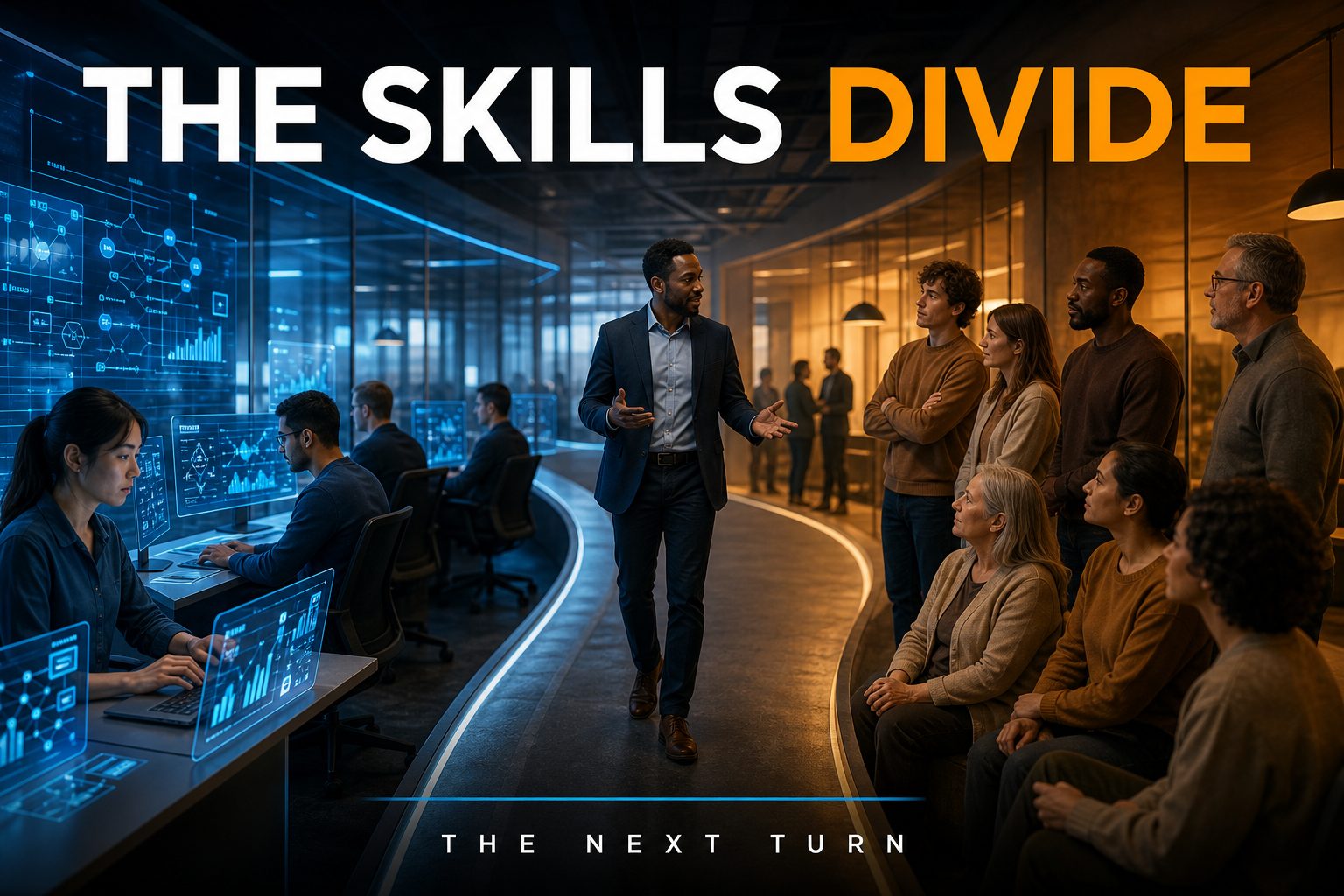
A new global survey suggests the AI skills divide inside organizations is widening. The question leaders should ask is not who is keeping up. It is who was given a real chance to.
That distinction matters. When some employees pull ahead with AI and others stall, it is tempting to read it as a difference in motivation. The data points somewhere else: access, training and clarity about how the work now gets done.
Key takeaways
- PwC’s 2026 survey of 49,364 workers found that AI is sorting the workforce into four groups with very different skills, access and confidence.
- The gap is not mainly about effort or attitude. Only 51% of workers said they have adequate learning resources, down from 59% last year.
- Employees who use AI daily trust their management more. Access to AI, and to learning, is part of the value exchange.
- Closing the AI skills divide is a manager and leadership design task: define where AI belongs, who gets to learn it, and how judgment will be seen.
What’s happening
On September 29, 2026, PwC released its Global Workforce Hopes and Fears Survey 2026. It covers 49,364 workers across 48 countries and regions and 29 sectors, surveyed in May and June 2026.
PwC sorted respondents into four groups based on the scarcity of their skills and their AI capability. Front-runners make up 14% of the sample. AI insurgents make up 18%. Indispensables, who hold scarce skills but have adopted little AI, make up 11%. The largest group, at 56%, is what PwC calls the engine room: people with non-scarce skills who are at an early stage with AI. HR Dive reported the same split on September 30.
Some of the numbers behind the groups are worth reading slowly. According to PwC, 64% of workers now use AI at work, up 10 points, and 22% use generative AI daily, up from 14%. But only 51% say they have adequate learning resources, down from 59%, and just 40% of the engine room group say they do. PwC also found that 29% of front-runners are likely to change employers within a year. Workers who use AI daily trust their management 15 points more than infrequent users do.
PwC’s global workforce leader, Pete Brown, put the risk this way: “There is a real risk that the global workforce is starting to move at different speeds.” In its coverage of the survey for Business Insider, Polly Thompson reports that the employer takeaway is that buying AI tools is not the same as transforming the organization, and that leaders need to communicate plainly about what their AI plans are for and extend access beyond their strongest performers. The survey also reports that Gen Z workers show higher anxiety on economic and job-security measures. As always, that is a finding about a broad group, not a fact about every young worker.
What this reveals about the AI skills divide
This is a story about the second turn in The Next Turn. In Chapter 2, I describe two changes happening at once. The first is the definition of work: what people believe work is for and what it should give them. The second is the structure of work: how work actually flows, and how AI compresses it and hides the process. The PwC findings sit mostly in the second turn, but they land on the first.
Start with structure. In Chapter 6, “AI Is Not a Tool,” I argue that AI is becoming infrastructure. A tool gets handed to individuals to figure out. Infrastructure changes the workflow around everyone. If a leader treats AI as a tool, a 56% engine room is predictable. A few curious people teach themselves. The rest wait for permission, training or clarity that never arrives.
Leaders who miss that will keep solving for adoption when they should be solving for redesign.
The Next Turn
Now the definition of work. Chapter 5, “The Value Exchange,” is about the three-year problem: value is assessed first, and loyalty is built only if the exchange proves itself. Learning and growth are part of that exchange for every generation, not just the youngest. When the people with the strongest AI skills are the ones most likely to be looking elsewhere, the exchange is being tested in real time. When the people with the least access feel least ready to adapt, the organization is asking for adaptation without offering the means.
Because the real response to the three-year problem is not expecting more loyalty. It is building work that is easier to believe in.
The Next Turn
There is also a standards-and-signals issue here. In Chapter 13, I separate standards, what the organization actually needs, from signals, the visible cues we use to infer them. “AI-savvy” is becoming a signal. It is easy to see who uses the tools daily. It is harder to see who exercises sound judgment with them. A workforce sorted by visible AI use can quietly reward the loudest adopters rather than the best decisions. The standards remain: quality, reliability, accountability, sound judgment. The proof system changes.
Which brings us to Chapter 12, “Defining Work Again.” The trust finding fits what I see in leadership teams: where AI’s role is unclear, people guess. Some hide their use, some overuse it, and some distrust fast output.
Ambiguity is not neutral.
The Next Turn
Your next turn
You do not need a company-wide program to start. Try these this week:
- Map the speeds. Look at one team and ask who is using AI daily, who is occasionally, and who is not at all. Then ask what each person has actually been given: time, training, permission and a clear definition of good work.
- Audit access, not attitude. Before you judge anyone as resistant, ask whether they have had a protected hour to learn, a real use case and a manager who can talk about it.
- Define AI’s role in one workflow. Write down where AI should help, where it should not, and what remains fully human responsibility. Share it with the people doing the work.
- Ask judgment questions. In your next one-on-one, replace “Did you finish it?” with “How did you decide?” and “What did you trust, and what did you verify?”
- Check your retention risk. If your strongest AI users would leave tomorrow, what do they get from staying that they could not get elsewhere?
Frequently asked questions
What is the AI skills divide at work?
It is the growing gap between employees who have the skills, access and confidence to use AI well and those who do not. PwC’s 2026 survey describes four groups, with the largest, 56% of respondents, at an early stage of AI adoption.
Why are some employees falling behind on AI?
The PwC data points to access as a major factor. Only 51% of workers report adequate learning resources, and only 40% in its engine room group do. That suggests the gap is shaped as much by what organizations provide as by what individuals choose.
What can managers do about uneven AI use on their teams?
Managers can define where AI belongs in the work, make time for learning, and evaluate decisions rather than just deliverables. In my work with leadership teams, AI readiness is largely manager readiness. Managers need their own support to do this.
The turn underneath the numbers
The PwC survey describes a workforce moving at different speeds. I would add one thing. Speed is not the same as direction. A workforce can be fast and still misaligned if no one has defined what good work looks like now.
The leaders who will handle this well are not the ones who buy the most tools. They are the ones who make explicit what used to be assumed: who learns, who decides, and what counts as good work when the process is no longer visible.
So look at your own team. Who is moving slowly because they lack the chance to learn, and what would change if you gave it to them?
Sources
- Companies risk losing their most AI-savvy employees while leaving majority behind, PwC, September 29, 2026
- AI skill levels drive workforce divide: PwC, HR Dive, September 30, 2026
- PwC’s huge survey of 50,000 workers says AI is splitting employees into 4 distinct groups, Business Insider via Yahoo Finance, September 29, 2026
