 Jeff Utecht
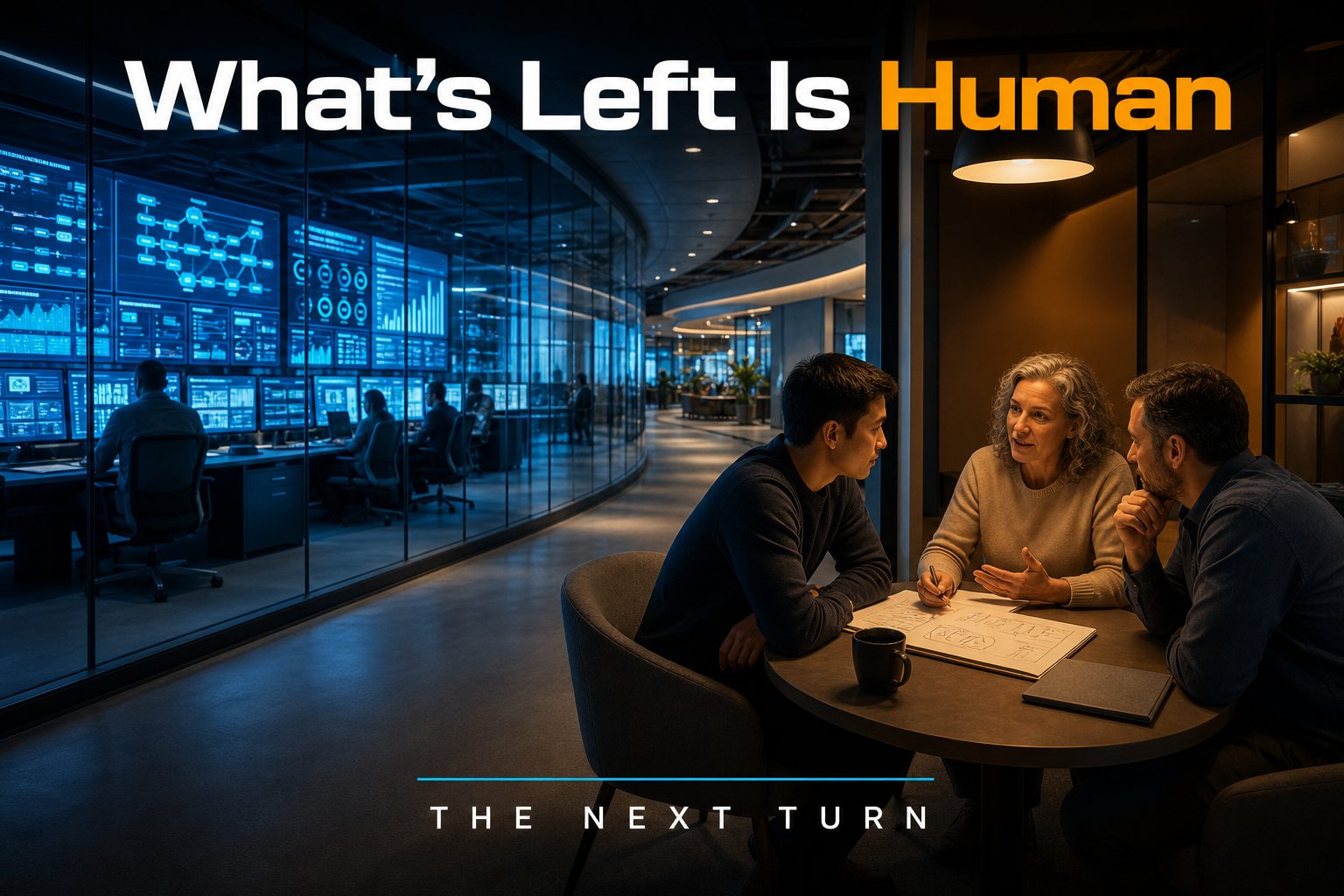
The conversation about AI and managers usually starts with one question: will AI replace them? This week’s reporting suggests a better question. AI is already taking parts of the manager’s job. The real issue is which parts, and whether anyone is deciding what is left.
Some of the work is clearly moving. The overnight report. The status dashboard. The two-hour meeting that existed mostly to pass information up and down the chain. Agents can do a lot of that now.
What they cannot do is the human part. Developing people. Owning outcomes. Explaining why the work matters. And right now, very few organizations have a plan for that part.
Key takeaways
- AI agents are absorbing the information work of management (gathering, reporting, monitoring), according to executive interviews published by Fortune on October 8, 2026.
- Only 4% of U.S. CHROs in The Conference Board’s Q3 2026 index say they feel very prepared to lead through AI-driven workforce change, and only 19% have built AI’s expected effects into enterprise-wide workforce planning.
- When the information work moves to systems, what remains for managers is the human work: developing people, translating meaning and owning outcomes.
- Organizations that do not redesign the manager role on purpose will simply compress it, and the people-development work is the first thing to get squeezed.
What’s happening
On October 8, Fortune published a commentary by Keith Ferrazzi and Wendy Smith, drawn from interviews with CIOs and senior executives, on how AI is unbundling the manager role. Their argument is not that management is disappearing. It is that management tasks are being pulled apart and reassembled. Some move into systems. Some land on people who do not have a manager title at all.
The examples are concrete. At CVS, agents prepare overnight reports and dashboards, and a daily two-hour management meeting has been cut to roughly 15 minutes focused on exceptions. CVS’s chief digital and technology officer, Pushpendu Pal, now spends less time on budget and status reporting and more on coaching and engineering work. Broadridge CTO Tyler Derr raised a question that stopped me: “How do you manage the change when you’ve got a leader with three human employees and 19 agents?” IBM’s Matt Lyteson put the shift simply: “There is going to be a bigger focus on outcomes versus output.” And at Whirlpool, CIO Eduardo Salas keeps a human owner on the decision to approve customer-facing material.
The authors recommend breaking the manager role into its parts (gathering information, monitoring, allocating work, developing people and owning outcomes) and deciding where each one should live. They also warn that without deliberate redesign, the role does not get better. It just gets compressed.
A day earlier, HR Dive’s Ryan Golden reported on The Conference Board’s Q3 CHRO Confidence Index. Only 4% of U.S. CHROs said they felt very prepared to lead through AI-driven workplace change over the next two years. Only 19% said AI’s expected effects were built into enterprise-wide workforce and financial planning, even though 67% said they had analyzed AI’s potential impact on jobs. The Conference Board’s own release adds that engagement was the clearest weak spot in the index: 24% of CHROs reported lower engagement, up from 16% the quarter before.
And on October 7, Fortune ran a commentary by Abbott’s head of human resources, Mary Moreland, arguing that AI will reward people who use it with sound judgment. She points to a Monster survey in which nearly nine in ten recent and upcoming graduates worry AI could replace entry-level roles, and argues that people still have to ask the right questions, spot errors and make the high-stakes decisions.
What this reveals about AI and managers
Put those three pieces side by side and a pattern shows up. The structure of work is changing first. By the structure of work, I mean how tasks actually flow: who gathers the information, who checks it, who decides. Agents are rewriting that flow inside management itself.
But planning has not caught up. Most organizations are studying the impact. Very few have redesigned around it. That gap is exactly where drift happens.
In Chapter 10 of The Next Turn, “Fractional Work and the Unbundling of Jobs,” I describe the full-time role as a bundle. It held many kinds of tasks together because communication and coordination used to be slow. The manager role may be the clearest bundle of all. A big share of it was information relay: collect the updates, summarize them, pass them on, check in again. When systems can do that relay, the bundle comes apart.
Here is the part I think leaders are missing. The information work was never the point. It was the visible part. It filled calendars and produced artifacts, so it looked like management. The harder work, the work of developing people and helping them understand why the work matters, often got whatever time was left.
Now the visible part is shrinking. The question is whether the freed time goes to the human work, or whether it simply disappears into more work.
In Chapter 5, “The Value Exchange (The 3-Year Problem),” I argue that retention is a design problem, not a motivation problem, and that manager design sits at the center of it. Managers are the people who translate the meaning of work. When they are overloaded with demands and have no time to explain the why, people experience the job as a list of tasks with no story attached. The Conference Board’s engagement numbers are a reminder that this is not abstract.
This also matters for early-career employees. If agents take over the reporting and the routine checking, the manager’s job of building judgment in newer people becomes more important, not less. Moreland’s point about judgment is right. But judgment does not show up on its own. Someone has to coach it.
Chapter 12, “Defining Work Again,” lays out seven moves for leaders. One of them is to make judgment visible and build managers who can see it. That move only works if managers have the time and the mandate to do it. As I put it in the book:
The leader who can approve tools but cannot define standards is not leading the work. They are standing beside it.
The Next Turn
A manager with three people and 19 agents is not just supervising output. They are designing a system. And the human beings in that system still need what humans have always needed from a manager: clarity, development and someone who owns the result.
Your next turn
If you lead managers, or you are one, here are a few moves for this week:
- List your actual management tasks. Use the five buckets from the Fortune piece: gathering information, monitoring, allocating work, developing people and owning outcomes. Estimate how your week splits across them.
- Mark what agents or systems could reasonably absorb. Be honest about how much of your week is information relay.
- Decide where the freed time goes before it is gone. Name one recurring commitment to developing people, such as a monthly career conversation or a weekly coaching block, and protect it.
- Name a human owner for every decision that matters. When agents do more of the work, ambiguity about who owns the result spreads quickly.
- Change one question in your one-on-ones. Replace “Where are we on this?” with “Talk me through how you decided.” Status can come from a dashboard. Judgment has to come from a conversation.
Frequently asked questions
Will AI replace middle managers?
The reporting this week points to something more specific than replacement. AI agents are taking over parts of the manager role, especially gathering information, reporting and monitoring. The parts that remain, such as developing people and owning outcomes, become more important. Whether that makes managers more valuable or simply more overloaded depends on whether the role is redesigned on purpose.
What should managers focus on when AI handles reporting?
Focus on the work that systems cannot do: coaching judgment, explaining why the work matters, setting clear standards and owning decisions. In The Next Turn, I argue that managers are the people who translate the meaning of work. That job grows as the reporting job shrinks.
How should HR leaders prepare managers for AI agents?
Start by breaking manager roles into their component tasks and deciding which ones should move to systems and which must stay human. Then build that into workforce planning. The Conference Board’s Q3 2026 index found only 19% of CHROs had built AI’s expected effects into enterprise-wide workforce and financial planning, so most organizations have room to move here.
The human part of managing
I have spent more than a decade working with leadership teams on how technology changes work. One lesson keeps repeating. When a tool takes over the visible part of a job, people assume the job got smaller. Often the opposite is true. The part that is left is the part that was always hardest to do well.
This moment is not only exposing weak leadership. It is making better leadership more necessary.
The Next Turn
If you want more on leading through these shifts, the Next Turn Leadership blog collects the rest of this series.
So here is my question for you. If an agent took over your status meetings tomorrow, what would you do with the time, and would the people you lead notice the difference?
Sources
- Your next manager may have three employees and 19 agents. Who’s accountable? — Keith Ferrazzi and Wendy Smith, Fortune (commentary), October 8, 2026
- Few CHROs say they feel very confident they can manage AI-driven change — Ryan Golden, HR Dive, October 7, 2026 (reporting on The Conference Board’s Q3 2026 CHRO Confidence Index)
- AI is a power tool. People are essential for using it — Mary Moreland, Fortune (commentary), October 7, 2026
