 Jeff Utecht
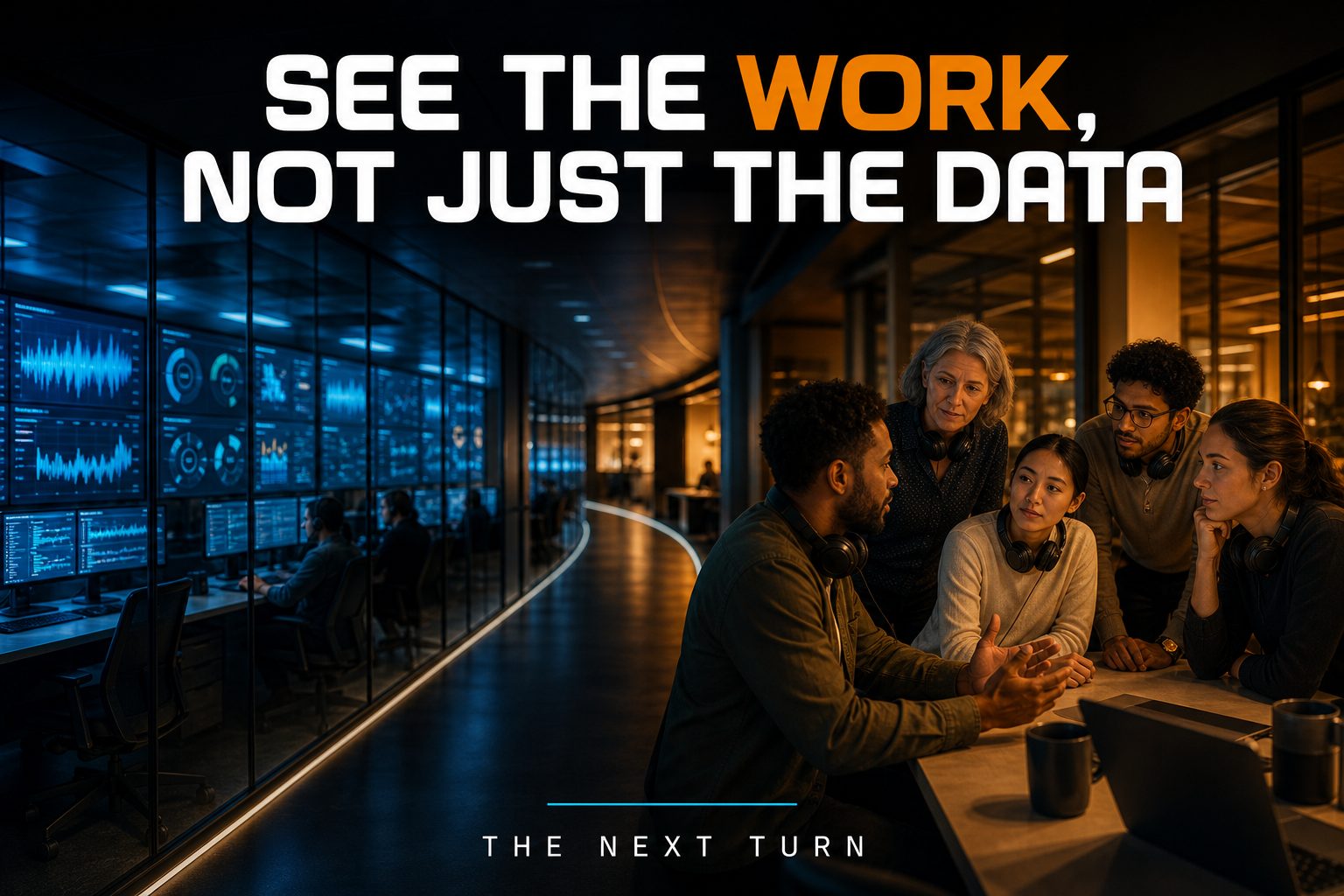
AI workplace monitoring is getting cheaper, easier and more detailed every month. An employer can now score every customer call, every keystroke and every word a cashier says at the counter. What the technology still cannot do is tell a leader whether the work was good.
That gap matters more than most leaders realize. When work gets harder to see, the instinct is to watch more closely. The research says that instinct usually buys stress, not performance.
More data about activity is not the same as more clarity about judgment.
Key takeaways
- AI is making workplace monitoring cheaper and more granular, from scoring every customer call to tracking keystrokes and tone of voice.
- Researchers cited in a new Knowable Magazine report find little evidence that electronic monitoring alone improves performance, and consistent evidence that it raises stress.
- Monitoring measures signals such as activity, scripts and speed. Leaders still have to define the standards, such as quality, judgment and care, those signals are supposed to represent.
- Workers who understand how they are monitored and how the data will be used report greater fairness and job satisfaction. Transparency is a leadership choice, not a software feature.
What’s happening with AI workplace monitoring
Two stories this week sit side by side. On October 15, a report produced by Knowable Magazine and distributed by Stacker, “Your boss is watching you: Workplace surveillance is on the rise, spurred by AI,” pulled together what researchers actually know about electronic monitoring. It notes that AI, cameras, sensors and tracking software now let employers follow location, call length and content, keystrokes per minute and even the tone and pitch of conversations with customers. The global employee-monitoring market is expected to exceed $4 billion in 2026.
The evidence on results is thinner than the market. Cornelius König of Saarland University, whose 2025 review found little evidence that electronic surveillance improves performance, put it plainly: “My general take is that [monitoring] isn’t going to matter as much as employers assume.” Daniel Ravid of the University of New Mexico led a 2022 meta-analysis covering more than 23,000 subjects that found no correlation between levels of monitoring and employee performance, and found that monitoring of any type tended to increase workplace stress. A 2024 study of more than 3,500 Canadian workers linked feeling surveilled to more pressure and stress and less autonomy and privacy.
The report also carries a quieter finding that leaders should not miss. In Ravid’s analysis, workers who clearly understood how they were monitored and how the data would be used reported greater fairness and job satisfaction than workers monitored with little explanation or consent. Ravid adds that managers “still need human insight and conversations to contextualize that data.”
The second story is a real-world test case. On October 12, Legal Futures reported that Co-op Legal Services defended its use of AI to monitor client calls. According to a whistleblower quoted by The Guardian, the system assesses more than 50 aspects of each call and gives managers pass and fail scores, and an anonymous staff member said it creates distrust. The firm rejected the “oppressive and dystopian” description. It said it has received no formal complaints, that the system lets it review all customer conversations to maintain service standards and support coaching, and that “human judgement, accountability, care and kindness remain at the heart of every client relationship.”
I want to be fair to both sides of that. The firm’s stated goal, consistent quality and better coaching, is a legitimate goal. The staff concern, that being scored on every word changes how people work and how much they trust, is also legitimate. The leadership question sits between them.
What this reveals: the product without the path
In Chapter 9 of The Next Turn, “Invisible Work,” I describe a shift every leader is starting to feel. Work used to leave a trail. Drafts, hours, visible effort and time at a desk gave managers a rough way to see how something got done. AI is erasing much of that trail.
Leaders increasingly see the product without seeing the path.
The Next Turn
That is a structure of work change. By structure of work, I mean how work actually flows: the tools, the steps and who or what does each part. When the structure shifts and the old trail fades, leaders reach for a replacement. Monitoring is the easiest replacement to buy.
But in Chapter 9 I argue that surveillance is the wrong answer to invisible work. It gives you more data about activity. It does not give you more clarity about judgment. And when leaders have not defined what trust is based on, the gap fills itself.
If those definitions remain vague, invisible work does not stay neutral. It turns into suspicion.
The Next Turn
Notice what the research describes. Workers habituate. They find workarounds, like tapping a keyboard while reading at lunch. Stress rises. That is what suspicion looks like once it becomes a system.
Standards vs. signals: what is a 50-point score actually measuring?
Chapter 13, “Building a Shared Definition of Good Work,” separates two things leaders tend to blur. Standards are what the organization actually needs: quality, reliability, accountability, sound judgment, follow-through, care. Signals are the visible cues we use to infer those standards: time, responsiveness, presence, detailed process, polished output.
Most monitoring captures signals. Keystrokes are a signal. A greeting said on cue is a signal. A checklist of call behaviors is a set of signals. Some of them may track the standard well. Some may not. Kirstie Ball of the University of St. Andrews raises exactly this point in the Knowable report: companies have to ask whether they are measuring what they think they are measuring.
This is where AI cuts both ways. AI can score more signals than any manager ever could. That does not make the signals more meaningful. It makes it easier to confuse a high score with good work, and easier for people to learn to perform for the score.
Chapter 13 also offers a principle I come back to often:
The amount of visibility should match the level of consequence.
The Next Turn
That is the idea of appropriate visibility. Some work carries real safety, legal or client risk and deserves close review. The Knowable report mentions a mining company that used fatigue-monitoring headbands to reduce fatigue-related accidents to almost zero. Other work does not need every word scored. The leadership job is to decide which is which, out loud, rather than letting the tool decide by default.
Your next turn
If you lead a team, or you are being pitched a monitoring tool, here are five moves for this week:
- Name the standard first. Before you look at any dashboard, write down the standard it is supposed to protect. If you cannot name it, you are buying signals.
- Match visibility to consequence. List the work on your team that carries high risk and the work that does not. Decide where close review is warranted and where it is just noise.
- Tell people exactly what is collected and why. The research links clear explanation to greater fairness and satisfaction. If you would be uncomfortable explaining it, that is information.
- Keep the conversation human. Use any data as the start of a coaching conversation, not the verdict. Ask, “How did you decide?” rather than “Why was your score low?”
- Ask what trust is based on here. In Chapter 12, one of the seven moves is to define what trust is based on. Do that with your team before a tool defines it for you.
Frequently asked questions
Does AI workplace monitoring improve employee performance?
The research summarized by Knowable Magazine says the evidence is weak. A 2022 meta-analysis of more than 23,000 subjects found no correlation between levels of monitoring and performance, and found that monitoring tended to increase stress. Gains, when they appear, tend to fade as workers habituate.
Is it ever appropriate to monitor employees with AI?
Yes, when the visibility matches the consequence. Safety-critical work or high-risk client work can justify closer review. The test is whether you can name the standard being protected, explain the system clearly to employees and keep a human conversation at the center of how the data is used.
How can managers build trust when they can’t see how work gets done?
Make thinking visible rather than activity. Define what good work means, agree on where AI is appropriate, and ask questions that surface judgment, such as “What did you trust and what did you verify?” Trust built on shared standards holds up better than trust built on tracking.
The real choice
AI will keep making it easier to watch work. That part is not in question. The question is whether leaders use that capacity to clarify what good work is or to substitute for defining it.
Monitoring can tell you that something happened. It cannot tell you whether it was the right thing to do. That still takes a leader.
So here is my question for you: on your team right now, is trust based on what people produce and how they decide, or on what you can see them doing?
Sources
- Your boss is watching you: Workplace surveillance is on the rise, spurred by AI — Knowable Magazine, distributed by Stacker (via Boston 25 News), October 15, 2026
- Co-op Legal Services defends use of AI to monitor client calls — Legal Futures, October 12, 2026
