 jutecht
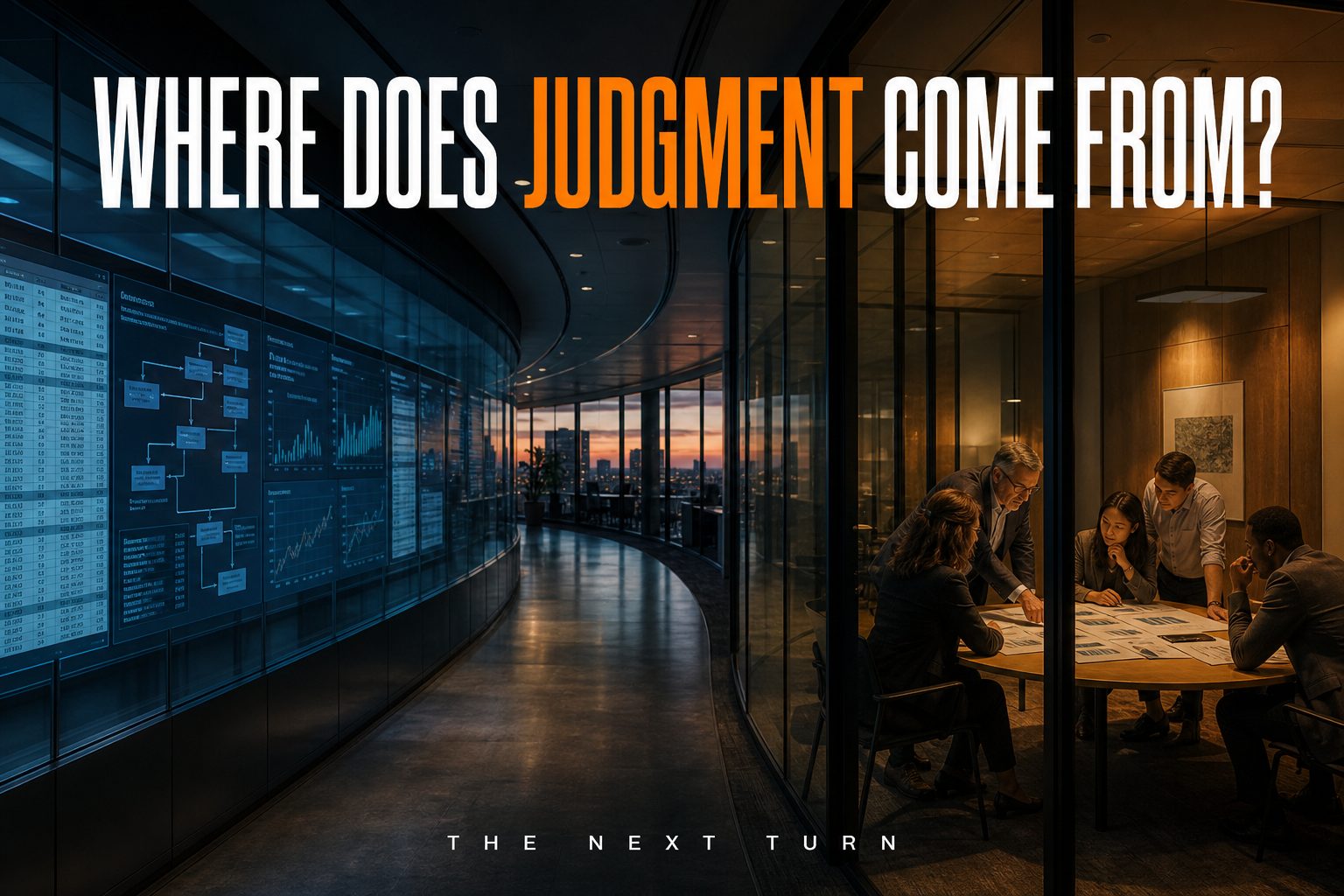
For most of the last century, the entry-level job did two things at once. It got the routine work done, and it quietly trained the people who would one day be trusted with the hard calls. Now AI is taking on more of that routine work, and a question about AI and human judgment is moving from the edges of the conversation to the center: if the tool does the junior work, where does judgment come from?
This week, two pieces of reporting put that question in plain view. One came from finance leaders. The other came from a global study of HR leaders and employees. Together they point to something I spent a full chapter of The Next Turn on.
Judgment is not disappearing. It is becoming the center of the work. But the path that used to build it is getting thinner.
Key takeaways
- AI is absorbing much of the routine work that early-career employees once used to build judgment, and leaders are starting to name that as a talent pipeline risk.
- An IBM study of 1,500 CHROs and 8,800 employees found that 60% of employees worry about skills erosion, with critical thinking cited most often as declining.
- Judgment does not develop by accident. When AI changes the structure of work, leaders have to design the experiences that used to build judgment automatically.
- The standard has not changed: someone still has to be accountable for the work. What has changed is how we prepare people to carry that responsibility.
What’s happening: AI is taking the junior work
On September 29, HR Dive republished a CFO.com report by Adam Zaki, asking how finance leaders will develop senior talent if AI takes on junior-level work. Brian Beaupre, CFO of Teikametrics, put it bluntly: “Quite literally, what these AI tools are doing today is what I did for the first 10 years of my career.” He added, “That struggle is where judgment comes from, and judgment is exactly what you can’t automate.”
Beaupre also named what worries him most: “the risk that leaning on AI too early in a career erodes the muscle of critical thinking.” Jeff Seibert, co-founder of Digits, an AI-powered accounting platform, made the accountability point directly: “The AI can never take accountability.” The article describes one response leaders are trying: pairing experienced staff with AI-comfortable newcomers so both technical skill and judgment get passed along.
A week earlier, on September 23, HR Dive’s Ryan Golden reported on a new IBM Institute for Business Value study warning that AI could erode the human skills CHROs consider vital. According to IBM’s release of the study, conducted with Oxford Economics from April to June 2026 and covering 1,500 CHROs and 8,800 employees, 60% of employees worry about skills erosion, with critical thinking cited most often as declining. Among those worried employees, three out of four say AI has already begun to erode at least some of their skills.
Two other findings stood out to me. First, 71% of CHROs identify the ability to supervise, validate and override AI outputs as the workforce’s most essential skill, yet only 29% of employees rank judgment as important. Second, 80% of CHROs believe AI adoption creates “invisible” work for employees, including validating recommendations, fixing mistakes, providing context and managing exceptions. And where judgment is built into how work is done, 62% of CHROs report growing employee confidence in AI-enabled decisions; where it is not, 57% report confidence declining.
Why AI and human judgment is a leadership design problem
This is a story about the second turn: the structure of work, meaning how work actually flows, who does which tasks and what tools sit in the middle. AI has changed that structure faster than most organizations have changed how they develop people.
In Chapter 8 of The Next Turn, “The Rise of Judgment,” I argue that judgment moves to the center of value as AI makes output abundant. Judgment has recognizable parts: framing a problem, choosing the standard, telling plausible from sound, understanding consequences, reading context and knowing when the tool is pulling the work off course.
AI does not reduce the need for human value. It changes where human value sits.
The Next Turn
Here is the tension this week’s news makes visible. The work that used to build those parts of judgment was often the routine work. Reconciling the numbers. Drafting the first version. Checking the details no one else wanted to check. It was not glamorous, but it left people with a feel for what sound work looks like.
When that work shifts to AI, two things can happen. Early-career employees can produce polished work earlier than ever. And that polish can create the illusion that judgment has been exercised. In Chapter 8 I note that younger employees can appear capable earlier than their decision quality justifies. That is not a criticism of anyone early in their career. It is a description of a system.
That is not an employee problem. That is a leadership design problem.
The Next Turn
The IBM gap between what CHROs value and what employees rank as important makes the same point from another angle. If 71% of CHROs see supervising and overriding AI as the most essential skill, and only 29% of employees rank judgment as important, the organization has not made its standard explicit. People cannot aim at a target no one has named.
There is also a connection to Chapter 9, “Invisible Work.” The validating, correcting and exception-handling that CHROs describe is real judgment work. It just does not leave much of a trail. If leaders only see the finished product, they miss both the judgment being exercised and the judgment that is missing.
And Seibert’s line about accountability lands right next to one of the seven moves in Chapter 12, “Defining Work Again.”
AI may participate in the work. It does not inherit responsibility for the work.
The Next Turn
The standard remains: someone is accountable for sound decisions. What changes is how people get ready to carry that. In the old structure, readiness was a byproduct of doing the junior work for years. In the new structure, it has to be designed.
Your next turn
Here are five moves leaders and managers can make this week.
- Map where judgment used to be built. Pick one early-career role. List the tasks AI now handles and ask, honestly, what those tasks used to teach. That list is your development gap.
- Name the judgment standard out loud. Write down, in plain language, where judgment must stay human-led in that role: what must be verified, what can never be approved without a person, and who owns the decision.
- Ask for the reasoning, not just the result. In your next review of a piece of AI-assisted work, try: “Talk me through how you decided.” Then ask what they trusted and what they checked.
- Build supervised decisions into the workflow. Give early-career employees real calls to make at a consequence level that fits their experience, with a more experienced colleague reviewing the reasoning, not just the output.
- Make the invisible work visible. Recognize the validating, correcting and exception-handling work on your team. If it matters, it should show up in how you talk about good work and how you evaluate it.
Frequently asked questions
How do employees develop judgment if AI does the entry-level work?
Not by accident. Leaders have to replace what the routine work used to teach with deliberate experiences: supervised decisions, conversations about reasoning and pairing with experienced colleagues. The finance leaders in HR Dive’s September 29 report describe pairing experienced staff with AI-comfortable newcomers as one approach.
Is AI eroding critical thinking at work?
Many employees believe it could be. In IBM’s study with Oxford Economics, 60% of employees said they worry about skills erosion, with critical thinking cited most often as declining. Whether that happens depends heavily on how work is designed around the tool.
Who is accountable when AI makes a mistake at work?
People are. AI can contribute to the work, but it cannot hold responsibility for it. Leaders should define, before problems arise, who owns each decision in an AI-assisted workflow and what must be verified by a person.
The path matters as much as the product
I do not think the answer is to slow AI down or to make early-career employees do things the old way just because that is how we learned. That would be romanticizing the past. But assuming judgment will simply show up on its own would be romanticizing disruption.
In Chapter 14, “The Leader as Translator,” I argue that the work stays human because the responsibility stays human. The question is whether we are building people who are ready for it.
So here is my question for you: in the roles on your team where AI now does the first draft, what are you doing on purpose to build the judgment that used to come from doing it yourself?
Sources
- If AI takes on junior-level work, how will CFOs develop talent? — HR Dive (originally CFO.com), September 29, 2026
- IBM report warns AI could erode human skills deemed vital by CHROs — HR Dive, September 23, 2026
