 Jeff Utecht
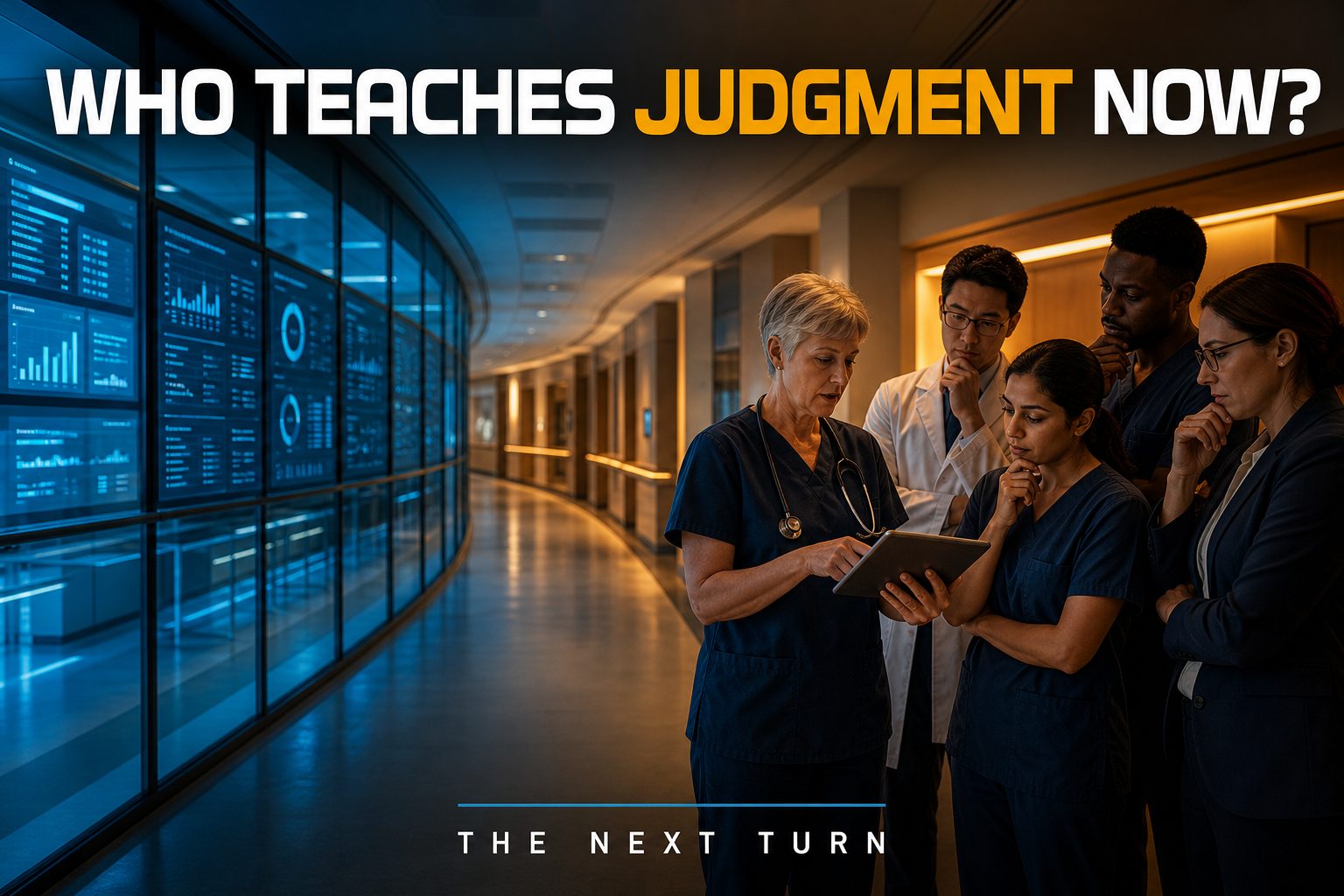
One of the largest professional services firms in the country just decided that critical thinking at work is too important to leave to chance. PwC US is going to train more than 85,000 people in it, assess them, and certify them.
That is worth paying attention to. Not because a certificate solves anything on its own, but because of what it admits. For a long time, organizations assumed judgment would grow on its own, as a side effect of doing the work. AI is changing the work. So that assumption no longer holds.
Judgment used to be a byproduct. Now it has to be a design choice.
Key takeaways
- PwC US announced on November 9, 2026, a Critical Thinking and Judgment certificate for more than 85,000 partners and employees, with rollout starting in December 2026.
- The move signals that judgment can no longer be treated as something people simply absorb over time; AI is changing the work where judgment used to be built.
- A certificate is a signal. Judgment shown in real decisions is the standard leaders actually need.
- Managers are where judgment becomes visible, which means building critical thinking at work is a manager-design question, not only a training question.
What’s happening
In a November 9 announcement on its newsroom, PwC US said it will equip more than 85,000 professionals across the US, Mexico and its Acceleration Centers with a Critical Thinking and Judgment certificate, built on the firm’s own Critical Thinking and Judgment Framework. The program starts with a diagnostic scenario, moves through the framework itself and masterclass-style videos with PwC leaders and outside thought leaders, and then uses personalized simulations. On-the-job toolkits, team collaboration scenarios and practical routines are meant to reinforce it. PwC says the framework is designed to help professionals navigate complex decisions, establish context, challenge information and assumptions, and communicate recommendations with clarity and accountability.
Built In reported on November 12 that the rollout begins in December 2026, with completion targeted for June 2027, and that PwC is refining the framework with academic input, including professors affiliated with the Wharton School and Harvard University. PwC also plans to make the framework available to universities and to fund selected schools to build introductory course materials, beginning in early 2027.
On November 16, HR Dive placed the program in a wider pattern. PwC framed the goal as strengthening the human capabilities essential to quality work and trust. HR Dive pointed to an IBM report in which 3 in 4 employees said AI has begun to erode at least some of their skills, with critical thinking the skill they most often named as declining. It also cited a Culture Amp report from September: most knowledge workers use AI, but only just over half said their leader had explained why they were using it.
Put those together and the story is clear. AI use is widespread. The reasons behind it are often unexplained. And the people using it worry that the thinking part of their work is getting weaker.
What this reveals about critical thinking at work
This is a structure of work story. By structure of work, I mean how work actually flows: who does which step, with what tools, and what the finished product hides. In The Next Turn, I argue that AI is changing that structure faster than most organizations are redefining what good work looks like inside it.
In Chapter 8, The Rise of Judgment, I make the case that judgment moves to the center of value as output becomes easier to produce.
AI does not reduce the need for human value. It changes where human value sits.
The Next Turn
Here is the part leaders tend to miss. Judgment was never taught in a classroom. It was built in the work. People learned to frame a problem by drafting the memo badly the first time. They learned what “sound” looked like by producing a lot of things that were only plausible and having someone more experienced push back. The struggle was slow and often frustrating, but it was where discernment came from.
AI compresses that struggle. In Chapter 7, The Collapse of Effort, I describe how effort does not disappear; it moves upstream, into framing, prompting, evaluating and checking. That upstream effort is exactly where judgment lives. And it is far less visible than the hours and drafts leaders used to watch.
So when a firm decides to teach critical thinking explicitly, I read it as an honest acknowledgment: the old apprenticeship path is thinning, and something has to replace it.
What increasingly separates people is not whether they can produce a first version. It is whether they can decide what that version is worth.
The Next Turn
A certificate is a signal. Judgment is the standard.
This is where I want leaders to slow down, because the risk is real.
In Chapter 13, Building a Shared Definition of Good Work, I separate standards from signals. Standards are what the organization actually needs: quality, reliability, accountability, sound judgment, follow-through. Signals are the visible cues we use to infer those standards: hours, responsiveness, polished output, and yes, credentials.
The standards remain. The proof system changes.
The Next Turn
A critical thinking certificate can be a useful part of a new proof system. It gives people shared language and practice. But if leaders treat completion as proof of judgment, they will have swapped one familiar signal for another. Visible effort used to stand in for good thinking. A badge could do the same.
It is worth noting that PwC’s own design points the other way. The program leans on simulations, on-the-job tools and team scenarios, not just a course. That matters. Judgment shows up in decisions, not in completion records.
This is not a criticism of training. It is a reminder of where training ends and leadership begins.
Why it matters for leaders outside professional services
You do not need 85,000 employees for this to apply. A charge nurse reviewing an AI-assisted care summary, a plant supervisor reading a predictive maintenance alert, a recruiter scanning AI-ranked candidates, a team lead editing an AI-drafted client email: each one is being asked to judge output they did not fully produce.
And the HR Dive reporting surfaces a quieter problem. If only about half of AI users say their leader explained why they are using it, then many people are being handed a faster structure of work with no new definition of what good thinking inside it looks like. Ambiguity does not stay neutral. People fill the gap themselves.
In Chapter 8, I also point out that polished AI output can make people appear capable earlier than their decision quality justifies. That applies to early-career employees, but it applies to everyone. It is not an individual failing. It is a design problem, and the design sits with leaders and managers.
Your next turn
Here are five moves for this week, whether or not your organization ever launches a formal program.
- Name where judgment lives in one workflow. Pick a single process your team uses AI in. Write down the two or three decision points where a human has to frame, check or override. If you cannot name them, neither can your team.
- Ask about decisions, not just deliverables. In your next review of AI-assisted work, ask: What did the tool produce, what did you change, and why? What did you trust, and what did you verify?
- Rebuild the apprenticeship on purpose. If AI now handles the first draft, decide where newer employees will practice the hard part. Have them critique AI output side by side with an experienced colleague and talk through the differences.
- Explain the why behind AI use. Tell your team why a tool is being used, what it is good at, where it should not be trusted, and what remains fully human responsibility.
- Do not treat training completion as the finish line. If your organization offers critical thinking or AI training, decide now how you will see that judgment in everyday work, through observation, feedback and real decisions.
Frequently asked questions
Can critical thinking at work actually be taught?
Parts of it can be practiced and strengthened deliberately: framing problems, challenging assumptions, checking sources, explaining a recommendation. But judgment grows through use. Training helps most when it is tied to real decisions and reinforced by managers who ask people to explain their reasoning.
Is AI weakening employees’ critical thinking skills?
Some workers believe so. HR Dive cited an IBM report in which 3 in 4 employees said AI has begun to erode at least some of their skills, most often critical thinking. Whether that happens depends heavily on how work is designed: when people only accept AI output, thinking weakens; when they are expected to evaluate it, thinking gets exercised.
What should managers do differently when teams use AI?
Shift questions from activity to reasoning. Instead of asking how long something took or whether it is finished, ask how the person decided, what they verified and what they changed. That makes judgment visible even when the process is not, and it tells people what actually counts.
The real question
PwC’s move is one firm’s answer to a question every organization now faces. If AI handles more of the production, where do people learn to think, and how will we know when they have?
A certificate can start that conversation. Only leaders can finish it, one decision at a time. You can find more on these ideas on the Next Turn blog.
So here is my question for you: in your team’s work right now, where is judgment being built, and where are you simply assuming it is there?
Sources
- PwC US to equip 85,000+ professionals with critical thinking and judgment certification as AI transforms work — PwC US Newsroom, November 9, 2026
- Consulting Firm PwC Launches Critical Thinking Certification for the AI Era — Built In, November 12, 2026
- Want to combat AI brainrot? PwC is piloting a way to do so. — HR Dive, November 16, 2026
